Verifiable Web Preservation: Why Simple Screenshots No Longer Stand Up in Court
In today’s digital landscape, taking a screenshot or saving a webpage as a PDF is the universal knee-jerk reaction when you need to record online evidence—whether to document copyright infringement, secure proof of defamation, build a legal dispute file, or preserve an online commercial agreement. However, from a legal and technical standpoint, these traditional methods fall remarkably short when subjected to judicial scrutiny or adversarial cross-examination.
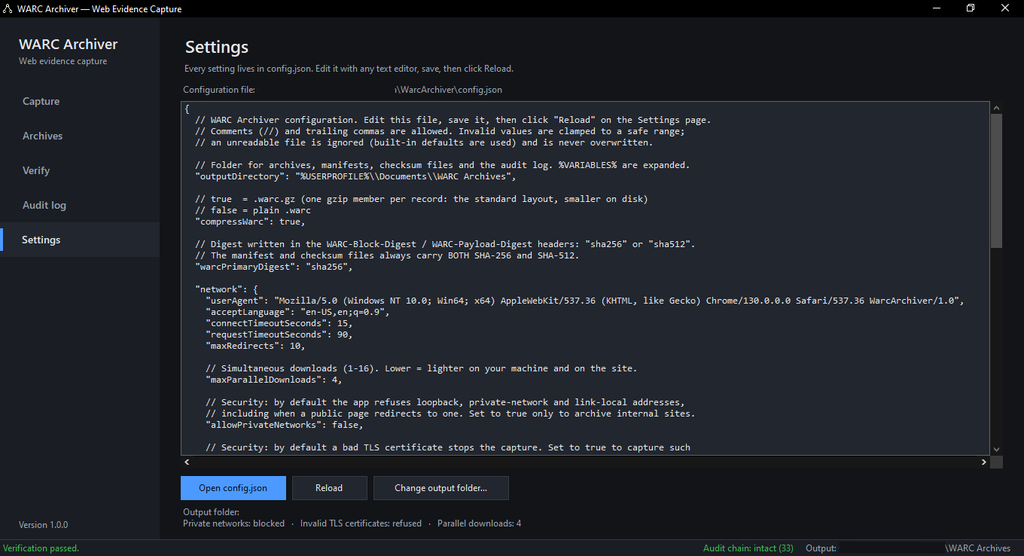
To address this critical gap, specialized open-source desktop solutions such as WARC Archiver—a Windows application built on C# 14 and .NET 10—have emerged to transform temporary online content into verifiable, tamper-evident digital evidence.
1. Why Screenshots and PDFs Are Obsolete as Evidence
A standard screenshot or PDF capture only records what a page looked like rendered on a specific screen. They fail to capture what actually transpired over the network connection. Furthermore, because images and PDFs can be effortlessly edited using basic graphics software or a web browser’s element inspector, opposing parties can easily challenge their authenticity in court.
Modern web preservation addresses this vulnerability by leveraging the WARC 1.1 (ISO 28500) standard—the exact format relied upon by national libraries and the Internet Archive. Rather than capturing a static visual representation, WARC Archiver captures the raw HTTP/HTTPS transaction byte-for-byte: the sent request, the exact server response, raw headers, HTML, stylesheets, JavaScript, images, the server’s IP address, and the complete TLS security certificate presented at the time of connection
2. How It Works: A Streamlined Protocol for High-Integrity Capture
Despite the complex cryptography running under the hood, WARC Archiver provides an intuitive desktop interface designed for seamless operation.
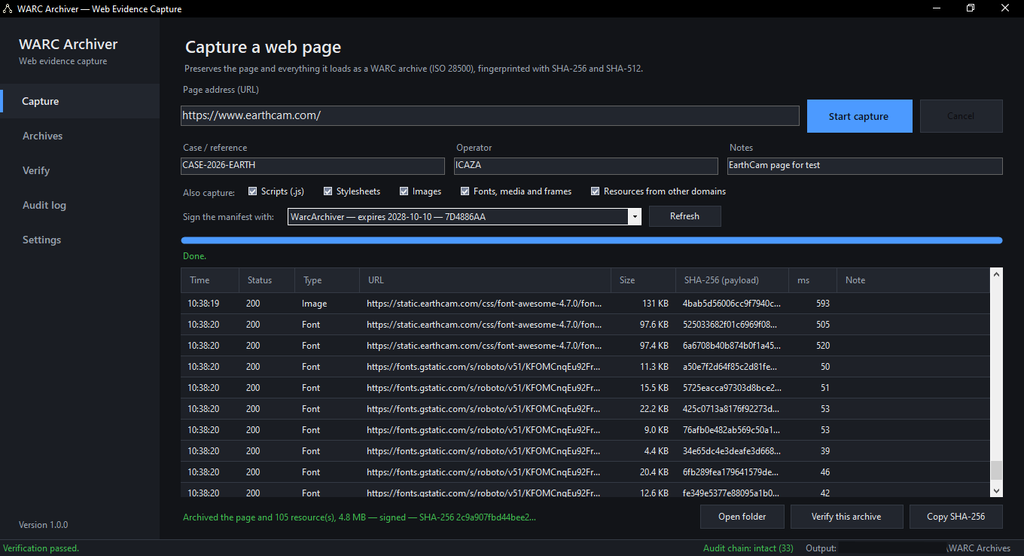
- Targeted Acquisition: The operator inputs the target URL (strictly
http://orhttps://), optionally enters a case reference and operator notes, and initiates the process. - Unaltered Raw Fetching: The application executes a dedicated HTTP/1.1 GET request without browser interpretation, automatic decompression, cookies, or caching. It follows redirects hop-by-hop and recursively parses and downloads associated assets (scripts, images, stylesheets, fonts, and frames) in parallel.
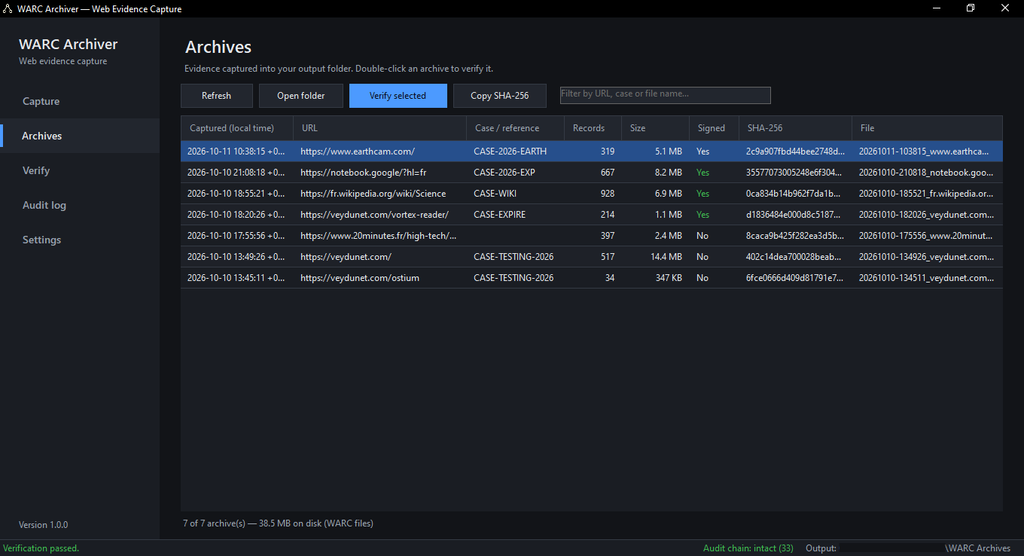
- Dual Cryptographic Sealing: Upon completion, the application writes the
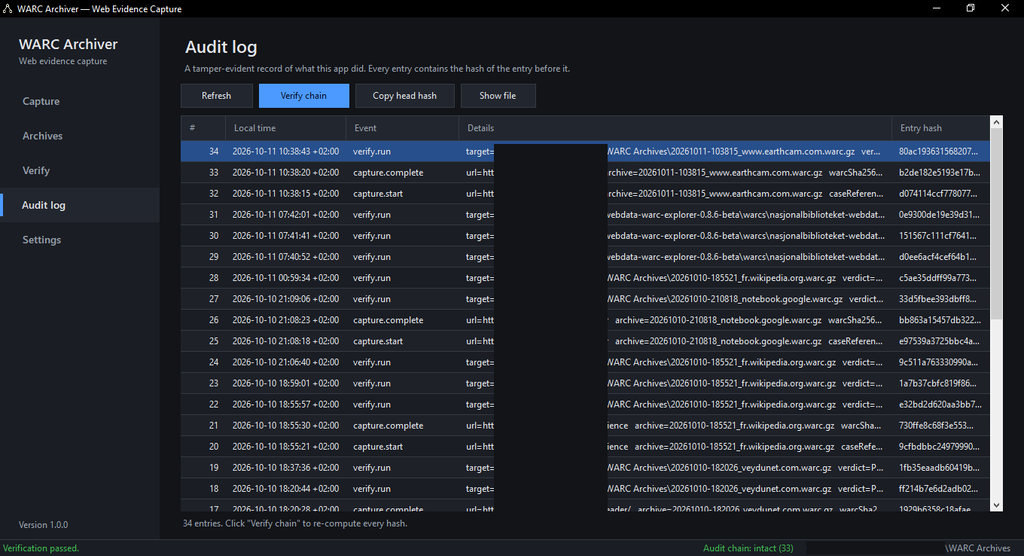
.warc.gzarchive along with a structured JSON technical record known as a manifest. Both the archive and manifest are fingerprint-sealed using dual parallel SHA-256 and SHA-512 cryptographic hash algorithms. - Tamper-Evident Audit Logging: Every event is written sequentially to a hash-chained audit log (
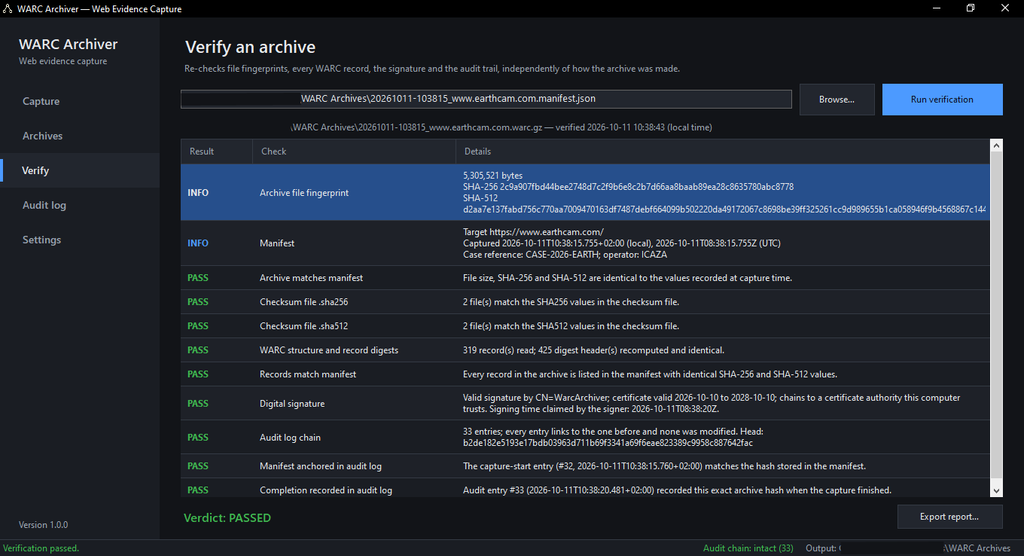
audit-log.jsonl). Each entry embeds the SHA-256 digest of the preceding entry. Modifying, inserting, or deleting any historical log line breaks every subsequent link in the chain. Completed files are automatically set to read-only. - Independent Verification: The built-in Verify module allows operators to re-check the integrity of the archive against the manifest. Because it adheres to the open ISO 28500 format, third parties, opposing counsel, or forensic experts can independently audit the evidence using open-source utilities like OpenSSL, Python’s
warciolibrary, or standard Windows PowerShell commands
3. Core Pillars of Digital Trust and the Legal Framework
For professionals – including IT managers, legal counsel, compliance officers, and business owners—establishing verifiable chain of custody for digital records is a vital risk-mitigation strategy.
The architecture of evidence-grade web archiving rests on key technical pillars.
- Fidelity & Integrity: Exact preservation of raw network bytes and triple-layer dual-digest hashing (archive, manifest, and individual records).
- Traceability & Timing: Full logging of local UTC timestamps alongside the server’s independent
Dateheader to measure clock drift. - Attribution: Support for attaching an X.509 digital signature (RSA or ECDSA) to the manifest using keys stored in the Windows Certificate Store.
Legal Context and Best Practices
Under international rules governing digital evidence—such as Rules 902(13) and 902(14) of the US Federal Rules of Evidence or Article 1366 of the French Civil Code and the EU eIDAS regulation—electronic data is admissible provided its origin is identifiable and its integrity is preserved under verifiable conditions.
To maximize evidentiary weight in disputes, professionals should follow a strict capture protocol.
- Synchronize the workstation clock prior to capture.
- Record clear case references, operator metadata, and contextual notes.
- Perform the capture, run the built-in verification, and export the validation report.
- Anchor the audit log’s head hash by transmitting it to an external third party (e.g., emailing counsel or depositing it with an officer/notary).
- Obtain a qualified RFC 3161 timestamp token for the manifest from a trusted timestamping authority
Operational Boundaries
To maintain full transparency, users should keep specific operational boundaries in mind.
- DOM as Served: The software captures HTML and scripts as served by the host, but does not execute post-load client-side JavaScript rendering (such as dynamic SPA single-page application hydration).
- Public Access Only: The tool only accesses publicly available pages without authentication, bypassing no paywalls, login forms, or session cookies.
Conclusion: An Essential Addition to Your Digital Toolkit
When online information can be altered or taken down in seconds, software like WARC Archiver provides a rigorous, transparent, and sovereign mechanism for preserving digital reality. Transitioning from passive images to ISO-standardized, mathematically verifiable, and cryptographically anchored archives ensures your digital evidence remains unquestionable when it matters most.