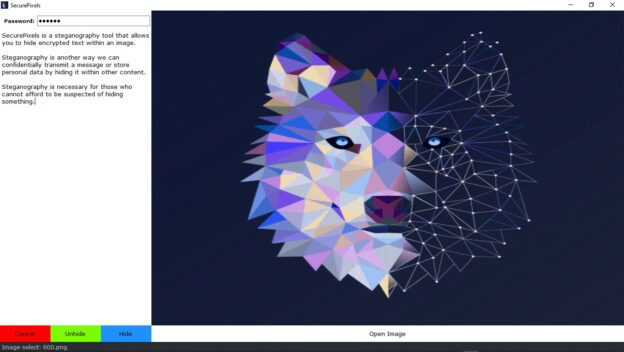
SecurePixels is a steganography tool that allows you to hide encrypted text within an image.
Steganography is another way we can confidentially transmit a message or store personal data by hiding it within other content.
Steganography is necessary for those who cannot afford to be suspected of hiding something.
AES encryption
Uses AES-256 with PBKDF2 key derivation
The message is encrypted before being hidden
Even with access to the image, it cannot be read without the password
Robust validation
File existence verification
Message size control (5000 character limit)
Image format validation
Automatic calculation of required vs. available capacity
Uncompressed BMP and PNG format
Supported pixel format verification
Perfect preservation of modified bits
Random distribution
Pseudo-random position generation based on the password
Uses all 3 RGB channels (triple capacity)
Reproducible seed for consistent extraction
Multi-channel RGB
Uses Red, Green, and Blue channels
Triple capacity compared to the original
Equal distribution across all channels
Enhanced security
Size limit on extracted data (protection against attacks)
Informative error messages without revealing sensitive information
Clean exception handling
Plus features
Display of percentage of capacity used
Detailed progress messages
Modular and maintainable code structure
Cryptographic robustness analysis:
1 Mathematical complexity of encryption
AES-256: 2^256 = 1.15 × 10^77 possible keys
Comparison: More than the number of atoms in the observable universe (≈ 10^82)
PBKDF2 10,000 iterations: Multiplies each attempt time by 10,000
2 Brute force decryption time
Computing PowerKeys/second Time for AES-256
Home PC10^63.7 × 10^63 years
Supercomputer10^153.7 × 10^54 years
Theoretical quantum computer10^183.7 × 10^51 years
3 Realistic attack scenarios
Dictionary attack
Vulnerability: Weak passwords
PBKDF2 protection: 10,000 iterations make each test 10,000× slower
Recommendation: Passwords > 12 characters with complexity
Password brute force attack
8-char password (a-z,A-Z,0-9): 62^8 = 2.18 × 10^14 possibilities
With PBKDF2 10k: 2.18 × 10^14 × 10,000 = 2.18 × 10^18 operations
Estimated time (modern GPU): ~69,000 years
Advanced cryptanalytic attacks
Current state: No known vulnerabilities in AES-256
NSA/Agencies: No public evidence of AES-256 compromise
Time horizon: Security estimated until 2050+ minimum
Real protection in case of discovery
If an attacker discovers your image with hidden message:
1 Bit extraction → Incomprehensible encrypted data
2 Pattern analysis → Uniform cryptographic noise
3 Encryption identification → AES visible but unbreakable
4 Password attack → Protected by PBKDF2
5 Result → Message completely inaccessible
Comparison with military/government standards
[NATO SECRET Standard] AES-256 encryption ⟹ SecurePixels Equivalent
[NSA Suite B Standard] AES-256 + SHA-256 encryption ⟹ SecurePixels Compliant
[FIPS 140-2 Standard] AES + PBKDF2 encryption ⟹ SecurePixels Compatible
Security conclusion
Even with steganography 100% compromised:
Decryption probability: 12 chars, complex)
No system compromise during encryption
No voluntary password disclosure
Cryptography constitutes your true protection, steganography being only an additional layer of obscurity. This is exactly the right security model!